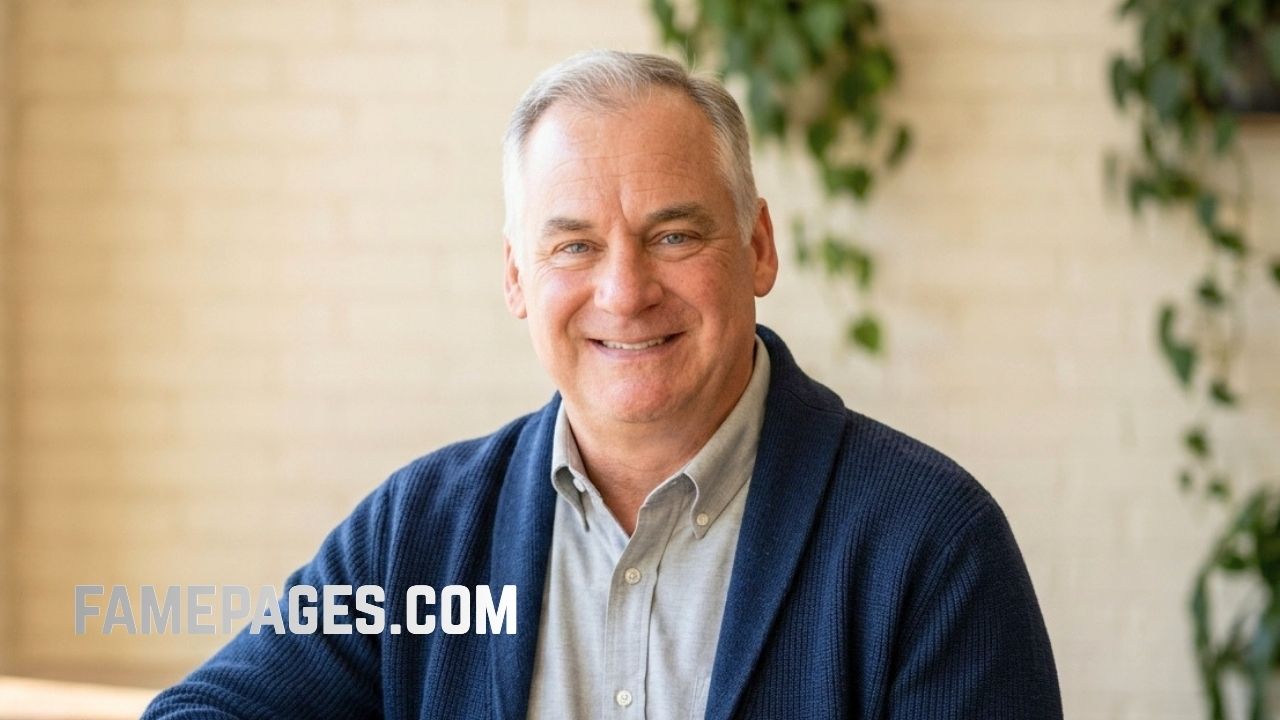

There is a small, strange moment buried in the credits of HBO’s Succession that most viewers scroll right past: a cable news anchor named Delta Pike, delivering breaking updates inside a show that spent four seasons dissecting exactly what cable news does to the people who consume it and the families who own it. Delta Pike wasn’t played by a working actress hired to look convincing behind a desk. She was played by Sharla McBride, a real television news anchor, doing the job she actually does for a living, inside a fictional version of the industry that employs her.
It’s a small credit, easy to miss. But it’s the detail that tells you the most about who McBride is and how she got here.
A Career Built the Way Local News Actually Works
Most profiles of television personalities skip past the résumé to get to the “moment” of arrival, the promotion or scandal or viral clip that made someone a name. McBride’s story doesn’t really have one of those. What it has instead is a map: Atlanta, then Abilene, Texas, then Scranton, Pennsylvania, then Philadelphia, then Washington, D.C., then New York. That progression isn’t incidental. It’s how broadcast journalism careers are actually built in the United States, market by market, each move representing a slightly bigger station in a slightly bigger city, earned rather than given. McBride’s résumé is, in effect, a visible timeline of a system that mostly operates out of public view.
The Twelve-Year-Old on the Couch
McBride has traced her interest in broadcasting to a specific afternoon: watching a Georgia football game with her father as a kid and noticing, for the first time, the person calling the action rather than the players on the field. That noticing stuck. She went on to study broadcast journalism at the University of Georgia, pairing it with a concentration in international affairs and foreign policy, from 2003 to 2007.
One detail from her college years says something about the unglamorous mechanics of the industry she was entering. A professor told her, bluntly, that her Southern accent would need to go if she wanted to work outside the South. So she trained it out of herself, deliberately, the same way an actor might prepare for a role. It’s a small thing, but it’s a reminder that the polished, neutral delivery viewers take for granted on air is often a skill learned under correction, not a natural gift.
Sidelines First
Her first real newsroom credit came as a college intern at WAGA-TV, Atlanta’s Fox affiliate, where she later worked as an associate sports producer. From there she moved to KTXS-TV in Abilene, Texas, covering high school and college sports as a reporter and fill-in anchor, and taking on the Dallas Cowboys as a beat during the 2007 and 2008 seasons. Beat reporting on an NFL franchise while still building a career in a mid-sized Texas market is the kind of assignment that teaches discipline fast: deadlines that don’t move, sources who don’t always want to talk, and a fan base that notices every mistake.
Scranton: The Long Middle
The bulk of McBride’s formative years in the industry happened in Scranton-Wilkes-Barre, Pennsylvania, at WNEP-TV, where she spent over a decade, from 2008 to 2020. She started as a sports anchor and reporter, then transitioned into full evening news anchoring, co-anchoring the station’s 6, 7, 10, and 11 p.m. newscasts on weeknights. This is the stretch of a broadcast career that rarely gets written about because it isn’t dramatic. It’s the long middle, the years of showing up for the same audience night after night, and it’s where her name picked up regional recognition, including an Excellence in Broadcasting honor for outstanding television public affairs work.
She also worked as a freelance sports anchor for what was then CSN Philadelphia, hosting “SportsNite” and covering Phillies pregame coverage, an arrangement that let her build a foothold in a bigger media market while still anchored in Scranton.
Washington, and a City That Didn’t Stop Making News
In March 2020, McBride joined WUSA9, the CBS affiliate in Washington, D.C., as a sports anchor and reporter. The timing turned out to be almost cruelly ironic. She has described being just four days into the new job when live sports shut down entirely because of the COVID-19 pandemic, leaving her, in her own words, with nothing to cover in the beat she’d just been hired for.
What followed reshaped her on-air identity. Freed from a sports-only lane, she found herself reporting on the wider churn of a capital city in crisis: the 2020 protests near the White House, a devastating apartment building explosion, and later, in January 2023, the on-field collapse of Buffalo Bills player Damar Hamlin, a moment she addressed directly and emotionally on social media as it happened. She also covered the aftermath of Sean Taylor’s death through his daughter’s reflections at his memorial, and was on hand for lighter political-adjacent coverage, including Donald Trump’s appearance at a LIV Golf event in Virginia. Across roughly three and a half years at WUSA9, McBride became a reporter who moved fluidly between sports desks and hard news, a versatility that hadn’t been asked of her earlier in her career.
Closing a Chapter, on Her Own Terms
In September 2023, McBride announced she was leaving WUSA9. Rather than a quiet exit, she posted a public, warm statement describing it as closing a chapter “after much thought and prayer,” while making clear she wasn’t leaving journalism itself. It read less like a standard industry departure and more like someone narrating her own turning point in real time, aware that her audience had followed her career closely enough to deserve an explanation.
Wake Up America, and the National Stage

The next chapter arrived quickly. In October 2023, Newsmax announced McBride as co-host of its morning program “Wake Up America,” alongside Rob Finnerty, relocating her to New York. After nearly seventeen years working exclusively in local and regional markets, it was her first genuinely national platform. Newsmax, a cable network known for its conservative editorial orientation, gave McBride a much larger built-in audience than any of her previous stations, airing weekday mornings from 6:30 to 9 a.m. Eastern. As of 2026, she remains in that seat.
The Fictional Anchor Playing Herself
Then there’s the detail that separates McBride from most local-news-to-national-TV stories: her appearances as an on-camera cable newscaster inside Succession, along with reporter and newscaster roles in Mr. Robot and Designated Survivor. Producers casting a show about a fictional media empire needed someone who could deliver breaking news copy the way real anchors actually do, under real studio lighting rhythms, without it reading as performance. McBride, working markets within reach of New York and Philadelphia production schedules, fit that need. It’s a small credit line in her filmography, but it captures something true about her: she has spent her whole career being exactly what television needs her to be, whether the cameras were rolling for real news or for a satire about it.
What the Public Record Doesn’t Settle
Not everything about McBride’s public profile is pinned down with certainty. Various unofficial biography sites cite an Emmy Award as her most consistently reported honor, though additional awards, including a Murrow Award, a SAG Award, and an Associated Press Award, appear in some listings and not others, without a single authoritative source confirming the complete set. Her net worth is similarly unsettled: some estimates place her annual income in the tens of thousands of dollars typical of local-market anchor salaries, while others speculate a net worth in the low millions reflecting nearly two decades of steady work. None of these figures come from McBride herself or from a verifiable financial disclosure, and they should be read as speculative estimates rather than fact.
Biography Snapshot
| Full name | Sharla McBride (@sharla_mcbride) |
| Born | December 28, 1984, Austin, Texas |
| Education | University of Georgia (2003 to 2007), broadcast journalism and international affairs/foreign policy |
| Current role | Co-host, “Wake Up America,” Newsmax (since October 2023) |
| Prior stations | WAGA-TV (Atlanta), KTXS-TV (Abilene, TX), WNEP-TV (Scranton, PA), CSN Philadelphia, WUSA9 (Washington, D.C.) |
| Scripted TV credits | Reporter/newscaster roles in Succession, Mr. Robot, Designated Survivor |
| Spouse | Todd Hiller (married 2013) |
| Stepdaughter | Maris Hiller |
| Awards | Emmy Award (most consistently cited); additional honors reported but not uniformly confirmed |
| Net worth | Not publicly disclosed; estimates vary widely and are unverified |
Frequently Asked Questions
How old is Sharla McBride?
She was born December 28, 1984, in Austin, Texas.
What does Sharla McBride do now?
She co-hosts “Wake Up America” on Newsmax, alongside Rob Finnerty, on weekday mornings.
Where did Sharla McBride work before Newsmax?
She spent roughly three and a half years at WUSA9 in Washington, D.C., preceded by over a decade at WNEP-TV in Scranton, Pennsylvania, and earlier stints in Abilene, Texas, and Atlanta.
Is Sharla McBride an actress?
Not primarily. She has appeared in on-camera newscaster roles in HBO’s Succession and in Mr. Robot and Designated Survivor, drawing on her real broadcast background.
Is Sharla McBride married?
Yes, she has been married to Todd Hiller since 2013, and the couple has a stepdaughter, Maris.
What is Sharla McBride’s net worth?
It has not been publicly disclosed. Online estimates vary considerably and should be treated as speculation rather than confirmed figures.
What awards has Sharla McBride won?
An Emmy Award is the most consistently cited honor across available sources; other awards are reported inconsistently and are not independently confirmed.
Where did Sharla McBride go to college?
The University of Georgia, where she studied broadcast journalism with a focus on international affairs and foreign policy.
Related Reading
- Lauren Green: The Faith, Music and Journalism Behind Her Career
- Kim DeGiulio: The Detroit Story Behind the WDIV Host
Final Thoughts
Sharla McBride’s story doesn’t hinge on a single viral break or a scandal that forced her into headlines. It’s built instead on something quieter and, in its way, more instructive: two decades of showing up in newsroom after newsroom, market after market, doing the unglamorous work of local broadcast journalism until it added up to a national platform. Her brief detour into scripted television, playing versions of the job she already had, only underlines the point. She has spent her career being convincingly, reliably herself in front of a camera, whether the news was real or the newsroom was a set. That kind of career rarely gets celebrated the way sudden fame does, but it’s the one most people in the industry actually have, and McBride’s is a clear, well-documented example of exactly how it works.